Sports & Adventure
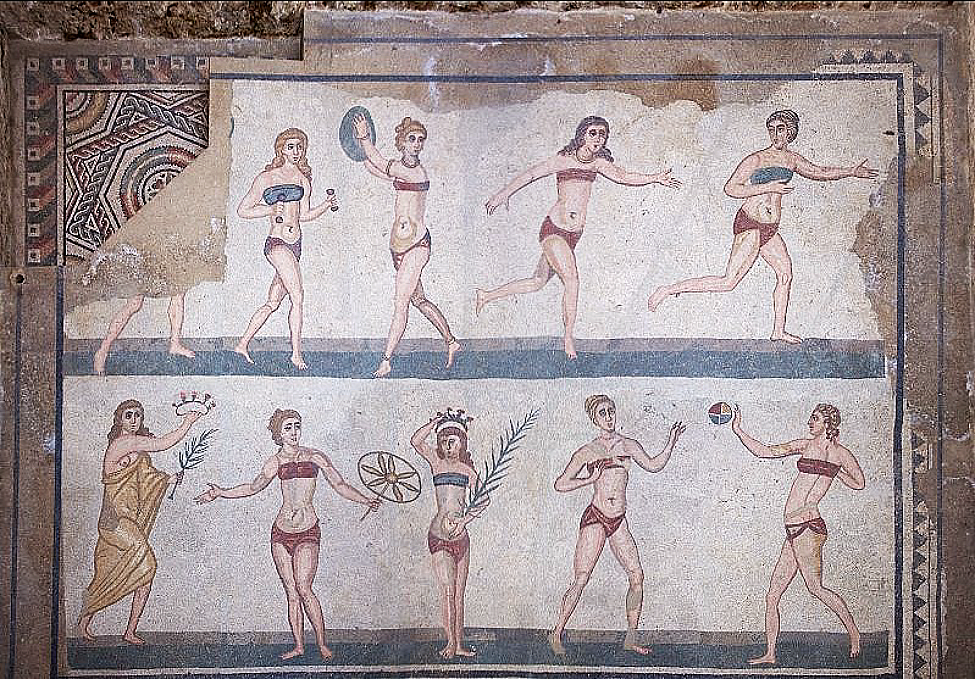
4th century Roman mosaic at Villa Romana del Casale, Sicily (nicknamed “The Bikini Girls Mosaic”)
Photo credit: Yair Karelic Photography
Read my 2012 paper: “Sleuthing Clues About a Roman Mosaic Starring Ten Sporty Women“
I live to run! –and hike, and bike, and swim. As a competitive endurance runner, I don’t race to finish, I race to win. Sometimes I dream we are having an earthquake and wake with a start. One time, though, when we had an actual 3 am, 6.-something quake, I laughed to myself, “I’m not fooled this time, I am just dreaming.” I kept my eyes closed and rolled over. Then all my race medals hanging from my bookshelves started going “clang clang clang clang clang.” I had never before realized that they could function as a tectonics alarm system.
This blog, however, seeks to celebrate all self-defined women who love to run, cycle, skate, dance, pump their biceps from wheelchairs, trek new lands, paddle new waters, ski distant mountains… It doesn’t matter if you are an Olympic or Paralympic athlete, a Sunday trail warrior, or someone who just bought your first pair of running shoes/roller skates. This blog supports you and encourages you!
Statement of Support for Transgender Female Athletes
I have been debating with friends who are generally supportive of trans rights but have mixed feelings about trans women athletes; so I feel compelled to assert my opinion on my own blog.
Because my scholarly areas of research include art, media, and media technology histories, naturally I am inclined to approach the debate about transgender female athletes from a historical framework. From that perspective, it seems the current hostility towards transgender female athletes as covered by the mainstream media is really a very old story: one of gender policing women’s bodies. In the nineteenth century, women were seen as too delicate to be athletic, and through the 20th and 21st centuries, debates have raged about who was deemed “feminine” enough to compete as a female.
Timeline of policing women’s bodies in sports
—see in particular 2014, oh my!
“Chand, an Indian sprinter, Olympic hopeful and national champion, is barred from competing against women because of her higher naturally occurring testosterone levels.” That is called discrimination.
Sources on Gender Policing in Sports
Here are some sources that look at the history of gender policing, which has included blood testing for chromosome patterns and testosterone levels, physical examination of genitals, and other degrading, demeaning, patronizing acts against women through modern/contemporary times. The best and strongest female athletes have often been the most aggressively targeted by the gender policing bodies. I suggest that this is because of sexist assumptions about what females are physically capable of: if you are too strong, too fast, too good…you must not be a “real” female.
Julie Compton, “Lia Thomas and the Long Tradition of ‘Gender Policing’ Female Athletes,” MSNBC, March 16, 2022, https://www.nbcnews.com/nbc-out/out-news/lia-thomas-long-tradition-gender-policing-female-athletes-rcna20091.
Mireia Garcés de Marcilla Musté, “You Ain’t Woman Enough: Tracing the Policing of Intersexuality in Sports and the Clinic,” Social & Legal Studies 31, no. 6 (May 2022): 847-870, https://doi.org/10.1177/09646639221086595.
Lindsay Parks Pieper, Sex Testing–Gender Policing in Women’s Sports (Champaign: University of Illinois Press, 2016), https://www.press.uillinois.edu/books/?id=p081682.
Amanda N. Schweinbenz, review of Sex Testing–Gender Policing in Women’s Sports by Lindsay Parks Pieper, Journal of Sport History 44, no. 3 (Fall 2017): 522-523, muse.jhu.edu/article/674914.
Mathew Wills, “Gender Incommensurability In Sports,” JSTOR Daily, 2022, https://daily.jstor.org/gender-incommensurability-in-sports/.
Sources on Female Physiology and Endurance Sports
While I am not a professional physiologist to frame the debate in depth from that perspective, as a distance runner I can say that I have been reading articles suggesting that women actually have some physiological advantages over bio-born males in endurance sports. So perhaps those politicians, athletes, and parents who are hostile to trans female athletes are not considering the distinct physiological aspects of different sports, let alone the spectrum of physiology that exists among female athletes.
Here are examples of research on female physiology and endurance sports:
Cole Grabowski, “Women in Endurance Athletics: The Further, the Faster,” Biomechanics in the Wild, University of Notre Dame, 2019, https://sites.nd.edu/biomechanics-in-the-wild/2019/03/05/women-in-endurance-athletics-the-further-the-faster/.
Ned Rozell, “Women May Have Advantage in the Long Run,” University of Alaska Fairbanks News, March 10, 2022, https://www.uaf.edu/news/women-may-have-advantage-in-the-long-run.php#:~:text=Women%20may%20be%20less%20susceptible,disadvantage%20over%20the%20long%20haul.
N.B. Tiller, K.J. Elliott-Sale, B. Knechtle, et al., ”Do Sex Differences in Physiology Confer a Female Advantage in Ultra-Endurance Sport?” Sports Med 51, 895–915 (January 2021), https://doi.org/10.1007/s40279-020-01417-2. [See fun infographics based on this article: https://evidencestrong.com/does-female-physiology-makes-them-better-at-ultra-endurance-sports]
Synthesized Thoughts
Gender is not binary. Sex isn’t always binary either: there are chromosome configurations beyond XX or XY. There is a spectrum of size, muscle mass, and testosterone levels among female athletes who were born as biological women–and among those athletes who started out males. There are rich women who can afford the best coaches and best gear, and women of lesser means who cannot. There are women who need to fight their cultural taboos to ride a bike–or even move through space–and those who are freer to engage in athletic activity. Yet, at international competitions, they are lumped together. It is never going to be a perfectly level playing field when competitions are divided into just two categories, “female” and “male.” The inclusion of trans athletes did not by any means create this age-old situation.
I had a friend argue that it is not just far-right culture war wagers who are skeptical of letting trans women compete as women because “the data” show they have an “unfair advantage.” I have not seen this data, who is publishing it, or how it is framed. Just for the sake of argument, though, let’s try on this friend’s position, even though it completely contradicts what the ACLU reports. If the data control for all other relevant factors, and there indeed turns out to be an unequivocal pattern that trans women disproportionately win solely because they are trans and for no other reason/s, then I think we need to ask ourselves:
What do we value as athletes and why?
Is it inclusion, sports-person-ship, celebrating our games, supporting each other, and encouraging one another to do our personal best?
Or is it prize money? As a culture, how do we position sports within a Capitalist framework and why? News flash: female athletes don’t get paid as much as male athletes. Might our energy be better spent fighting for pay parity with men rather than fighting the very small percentage of athletes who are transgender? Might it all be…a distraction?
[Aside from the author reared in Appalachia: the coal miners, steel workers, and other laborers who wreck their bodies just as much as pro athletes–or lose limbs and eyes on the job–don’t get paid like celebrity-level male athletes, either. So again, what do we value, whom do we value or undervalue, and why?]
But hey, at least right-wing male politicians are finally recognizing that female athletes are athletes! For decades they have only ignored, objectified, delegitimized—and underpaid—us. Can we leverage this moment to the benefit of all athletes who identify as female when given the still-binary categories of sports competitions?
This author fully supports trans female athletes. Come run with me!
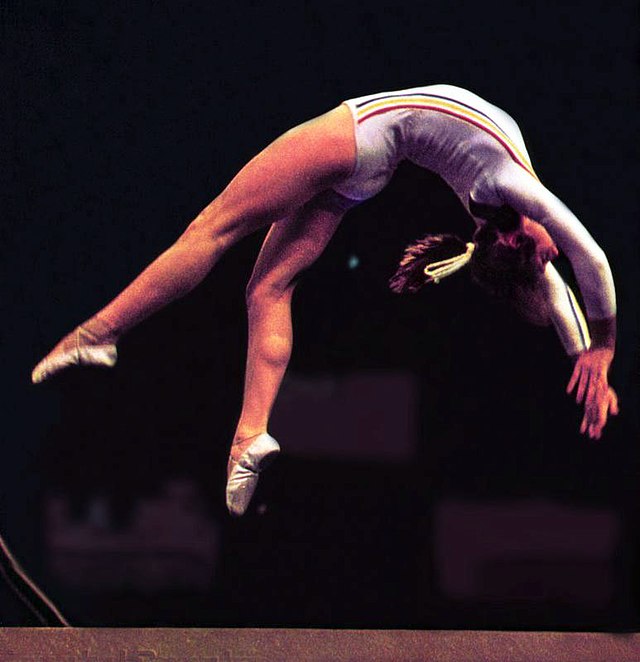
(Photo from Wikimedia.)